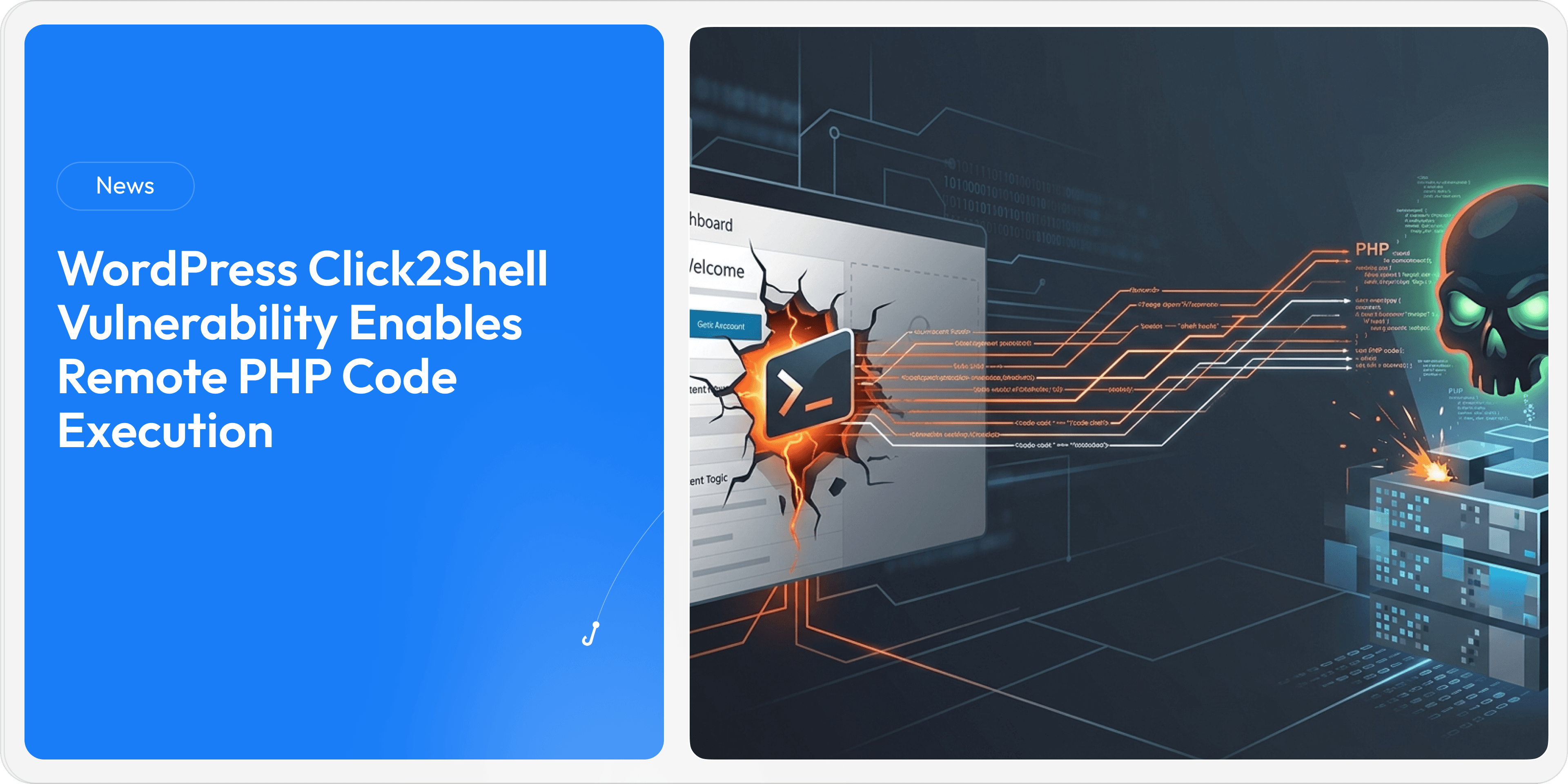
WordPress Click2Shell Vulnerability Enables Remote PHP Code Execution
Sep 22, 2026
A newly disclosed WordPress vulnerability, dubbed Click2Shell, allows attackers to execute arbitrary PHP code on vulnerable websites through a cross-site request forgery (CSRF) attack chain. The vulnerability affects WordPress Core versions 7.1.0 and earlier and was addressed in WordPress 7.1.1.
Discovered by security researcher Paulos Yibelo of pwn.ai, the flaw enables attackers to force-install a theme from the official WordPress.org catalog and execute malicious PHP code through the WordPress Customizer. Although the attack does not require the attacker to authenticate, a logged-in administrator must visit a specially crafted URL for the exploit to work.
Key Facts of the Incident
Category | Details |
|---|---|
Vulnerability Name | Click2Shell |
Threat Type | Cross-Site Request Forgery (CSRF) leading to Remote Code Execution |
Affected Software | WordPress Core 7.1.0 and earlier |
Fixed Version | WordPress 7.1.1 |
Attack Mechanism | Forced theme installation followed by PHP code execution through Customizer preview |
Authentication Required | No attacker account required, but a logged-in administrator must visit a crafted URL |
Researcher | Paulos Yibelo, pwn.ai |
Disclosure Date | September 21, 2026 |
Potential Impact | Arbitrary PHP execution, file modification, data access, and malicious administrator account creation |
Recommended Mitigation | Update WordPress to version 7.1.1 or later and apply additional security controls |
What Happened?
Security researcher Paulos Yibelo reported the Click2Shell vulnerability to WordPress on August 22, 2026. The flaw involves the way WordPress processes theme preview URLs and how JavaScript in an administrator's browser handles the resulting data.
According to the research, a value from a WordPress theme-preview URL is processed by the WordPress.org Themes API and then handled incorrectly by JavaScript in the administrator's browser. This enables an attacker to trigger the installation of a theme without the administrator explicitly installing it.
The attack works through the following sequence:
Crafted Malicious Link: An attacker prepares a specially crafted URL designed to exploit the WordPress theme preview functionality.
Administrator Interaction: A logged-in WordPress administrator visits the malicious link.
Unauthorized Theme Installation: The vulnerability allows a theme from the official WordPress.org catalog to be installed without the administrator intentionally initiating the installation.
Customizer Preview: The installed theme is loaded through the WordPress Customizer, where its PHP code can be executed.
Remote Code Execution: The attacker achieves server-side execution of arbitrary PHP code through the exploit chain.
The attack requires administrator interaction, but the attacker does not need a WordPress account, installation nonce, or administrative privileges of their own.
Technical Details
Cross-Site Request Forgery (CSRF)
Click2Shell exploits a vulnerability in WordPress Core's handling of theme-preview functionality. The flaw allows an attacker to manipulate requests initiated through an administrator's browser.
The vulnerability involves the processing of theme slugs in WordPress JavaScript. WordPress addressed the issue in version 7.1.1 by escaping the theme slug before using it in a jQuery selector and restricting the selector to actual theme cards.
Arbitrary PHP Code Execution
The vulnerability becomes particularly serious when combined with a vulnerable theme. During the Customizer preview, PHP code associated with the theme can execute on the server.
In a proof-of-concept demonstration, pwn.ai used a vulnerable WordPress theme to execute attacker-controlled PHP code. The researcher also published technical details and a proof-of-concept exploit.
No Direct Attacker Authentication Required
Unlike conventional attacks that require an attacker to log in to a WordPress account, Click2Shell does not require the attacker to have their own account or administrative permissions.
However, the attack depends on a logged-in administrator visiting a crafted URL. This makes targeted phishing and other administrator-focused attack techniques relevant to the vulnerability's exploitation.
Potential Impact & Risks
Successful exploitation could allow attackers to execute malicious PHP code on the affected WordPress server. Depending on the server's permissions and configuration, this could lead to:
File Modification and Deletion: Attackers could alter or remove website files.
Sensitive Data Exposure: Attackers could access website data, including information stored in
wp-config.php.Database Credential Theft: The
wp-config.phpfile may contain database credentials and authentication secrets.Unauthorized Administrator Accounts: Attackers could create rogue administrator accounts.
Malicious Script Injection: Attackers could inject malicious scripts into websites.
Server-Side Remote Code Execution: Attackers could execute arbitrary PHP code on the server.
The actual impact depends on the website's configuration, server permissions, and the level of access available to the executed code.
Who Is at Risk?
The vulnerability affects WordPress Core version 7.1.0 and earlier. The underlying flaw could be used to force-install vulnerable themes from the official WordPress.org catalog.
Patchstack's analysis highlights that the attack requires an administrator-level account to trigger the relevant functionality. Author and Editor accounts do not have the necessary permissions to install themes.
Organizations running WordPress websites should pay particular attention to:
Websites operating on outdated WordPress versions.
Administrators who frequently access links from emails or external messages.
Websites that allow theme installation and modification.
WordPress installations without adequate access controls and monitoring.
What Organizations Should Do
1. Update WordPress Immediately
Organizations should update WordPress to version 7.1.1 or later, where the Click2Shell vulnerability has been addressed.
The availability of a public proof-of-concept makes timely patching particularly important.
2. Restrict Theme and Plugin Installation
Patchstack recommends enabling the DISALLOW_FILE_MODS configuration where appropriate. This can prevent forced installation of themes or malicious plugins, although it may also restrict legitimate website management activities.
3. Strengthen Administrator Security
Administrators should exercise caution when opening links received through email or other communication channels. Organizations should also apply appropriate access controls and monitor administrator activity.
4. Review Website Integrity
Security teams should inspect websites for unexpected changes, unauthorized administrator accounts, suspicious scripts, and other indicators of compromise if exploitation is suspected.
5. Conduct Security Testing
Organizations can use authorized vulnerability assessments and penetration testing to identify weaknesses in WordPress configurations, administrative workflows, and access controls.
Why This Matters
The Click2Shell vulnerability highlights how a seemingly ordinary administrator interaction can become part of a server-side remote code execution attack.
While the vulnerability requires a logged-in administrator to visit a crafted link, the attack chain demonstrates the security risks associated with combining browser-based request manipulation, theme installation, and server-side code execution.
For security teams, patch management and administrator-focused security awareness should work together. Updating WordPress addresses the underlying vulnerability, while educating administrators about malicious links can help reduce the likelihood of successful social engineering attacks.
Organizations should prioritize timely updates, restrict unnecessary administrative capabilities, and regularly assess the security of their WordPress environments.